Featured Digital Artists


Charles Csuri


"Mask of Fear"I created the painting of a mask-like face with my old oil paints and brushes. In part I reveal my love for expressionism. The texture map of the painting on different surfaces and at varied sizes seems to extend my original painting. The notion of copies of the same object with transformations in the world space has been with me since the early 1960's.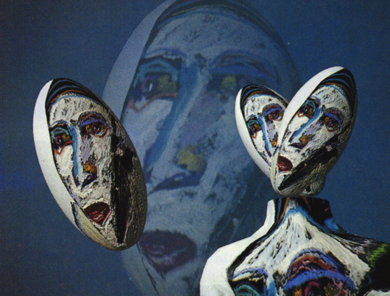 "Phases of Mourning"This work was inspired by Masaccio's painting Expulsion From The Garden of Paradise. Perhaps I'm making a comment about something else. I use the same figure everywhere but in different poses I also depend upon body language and degrees of fragmentation to express the feelings of remorse.
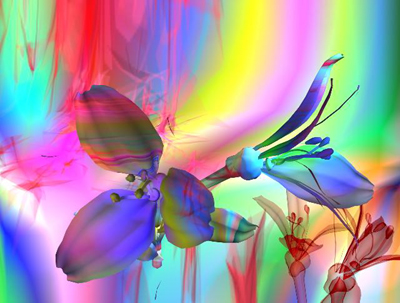
 "Wonderous Spring, 1992"I tried to make color work more like light. The same texture map was used on both the flower and the background. Alignments of the two texture maps helps with the feeling of color atmosphere. The inspiration for this work came from my wife Lee's flower garden.
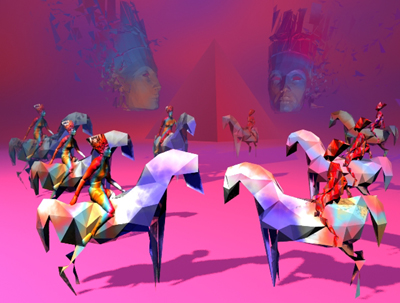
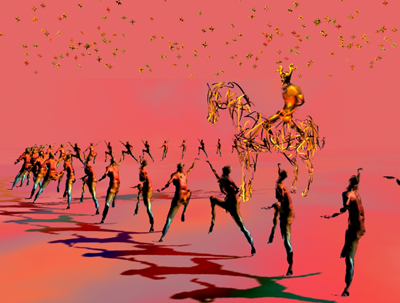
 "Ancient Ritual, 1997"I had fun with decimation code reducing my horse and figure to a simple version. The play between the simple and complex, the chaotic or fragmented and enclosed representations has always interested me.
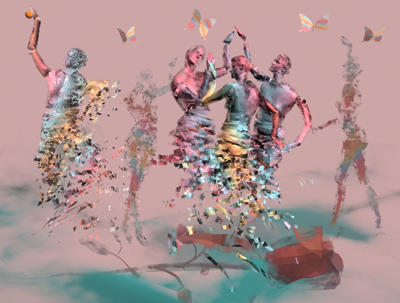
 "La Primavera, 1997"Here is my notion of La primavera by Botticelli. The rose is in the space but you can only see it's shadow. I wish I could do something about fingers and thumbs but I don't yet have the necessary data.
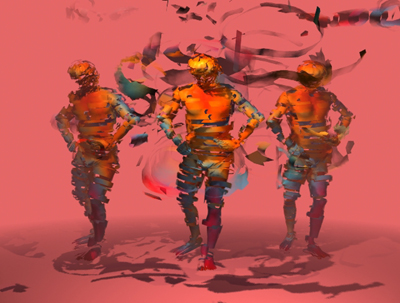
 "Cezanne's Bather, 1996"Cezanne hated chiaroscuro and this is my interpretation of one of his bathers. It's the one in the Museum of Modern Art. I used to work with his concept of the "passage shape."? I wonder if there is anybody still out there alive who knows what that means? Cezanne was on of my heroes when I was young and trying so hard to be "avant-garde". What a stupid notion.
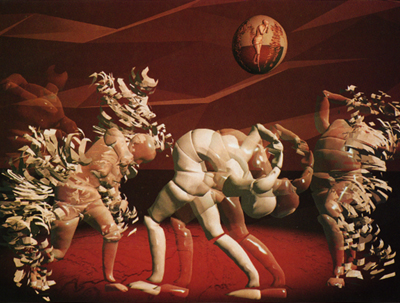
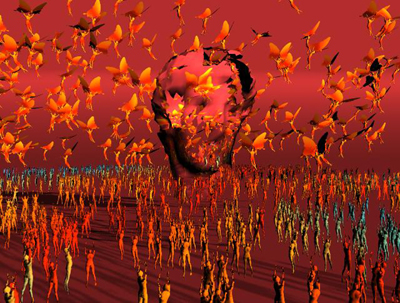
 "Where do we Look, 1997"Besides the head, the scene has only two basic figures. I made copies of each of them and there are 2050 figures in the scene. Their representations are at different levels of detail. A decimate function reduced the polygon count and yet preserved the basic geometry of the figure. The lighting was especially difficult to set because there was so much data.
 "Root of Evil, 1998"The character on the horse has a goatee and it could be Bill Gates. He has all of the power and everybody is paying homage to him. Those are really multicolored shadows and not objects
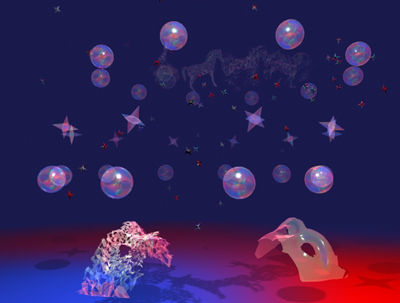
 "Magical Moment"The same mask was used but I applied the fragmentation function to one of them. I needed one to look like a delicate material or simply different. Each mask has its own spotlight assigned to it. The glass spheres and the stars have an environment reflection of my image Introspection. Aurora the Goddess of Dawn is riding the universe casting her shadow upon our world. Soon we will begin a new day.
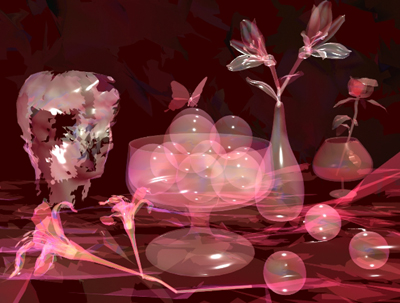
 "Crystal Clear"A special function was used to make objects look like glass. I had to play back and forth with different settings for the transparency. Many of the spheres inside the bowl intersect but I think it makes it more interesting. All of the models were mathematically generated using functions that affect geometry. The head data was scanned by a laser beam and automatically recorded into the computer.
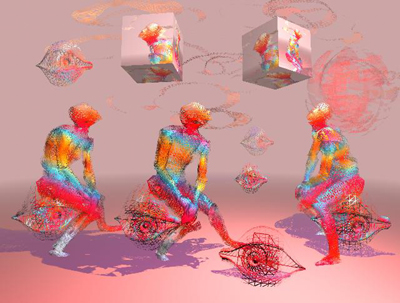
 "Introspection"I first made the image without the cubes. The I took sections of the image and mapped them onto the sides of the cube. My function to generate lines was used. I have a control to determine the thickness of the line. I used my system to pose figures and I was influenced by a Rodin sculpture.
 "Sleeping Gypsy"I have always loved the Sleeping Gypsy by Henri Rousseau in the Museum of Modern Art. I first posed the figure and then I used the fragmentation function. In the sky the horses were also fragmented in several steps. I used a face and combined it with a sphere to make the moon.
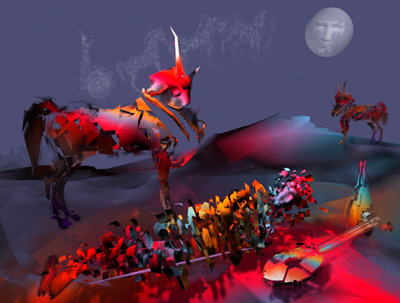 "Ribbon Romp"The function to create ribbon like lines was used. I simplified the figure before I applied the ribbon function. I jumped back and forth with the thickness of the ribbon before I made up my mind. My young granddaughter Hannah was the influence on this piece.
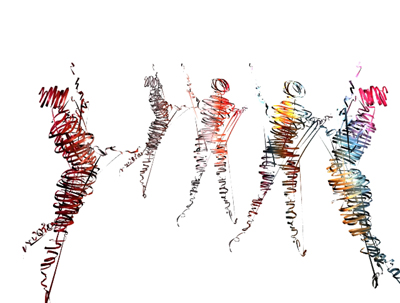 "The Past Casts Shadows"I used a function which makes copies of the same horse and rider model. They were randomly placed onto the plane inside a box. The box can be scaled and shifted. I struggled a long time to place the spotlights which cast the shadows.
 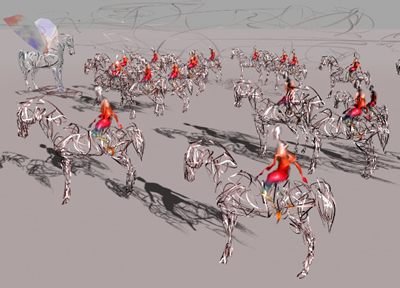 "In Search Of Meaning"The place-ring function was used to create the circle of masks. Another function which allows me to convert polygons into lines was applied to St. Paul's Cathedral. I used a function to control atmosphere and created a gray-purple like fog in the background. I have controls over the position of the fog. I have a function to poke holes into objects.
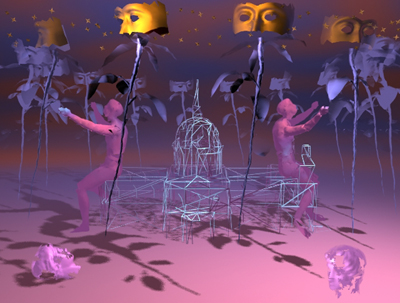 "Horse Play"A mathematical function was used to create the ribbon like lines. The lines move through points on the surface of a 3d model of a horse. There are controls to skip points, cut the lines and control the thickness of the line.
I like the capacity to work with lighting on the lines using spotlights. The lines then cast shadows in ways which are interesting and fun. I cut out a section of the horse with another tool and placed it into the sky. I made it's line thicker and semi-transparent.
"Horse Play"A mathematical function was used to create the ribbon like lines. The lines move through points on the surface of a 3d model of a horse. There are controls to skip points, cut the lines and control the thickness of the line.
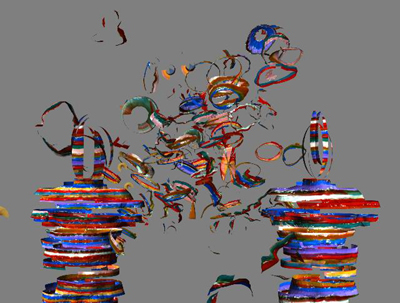
I like the capacity to work with lighting on the lines using spotlights. The lines then cast shadows in ways which are interesting and fun. I cut out a section of the horse with another tool and placed it into the sky. I made it's line thicker and semi-transparent.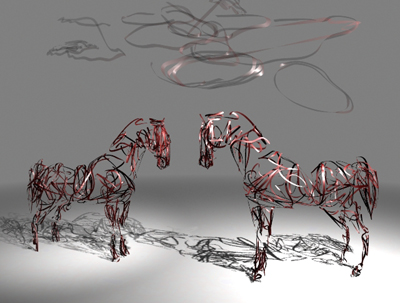 "Gossip"A function for fragmentation was used to break the figure into pieces. It has the capability to make clusters of fragments, control their range of displacement and to rotate them. The center section is the same as the figures on the sides but with a greater displacement. I made a painting of just stripes. My painting was scanned and then I mapped it onto the 3d models.
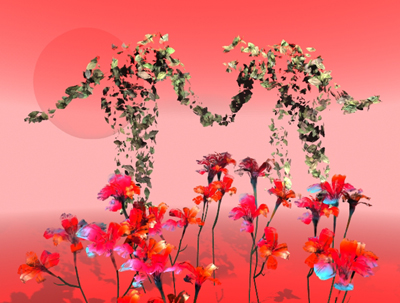
 "Garden Lovers"There are only two basic objects in this image, the figure and a daylily. I used a function to place leaf elements onto the surface of the figure. There are controls to set ranges for each leaf's rotation, color and size. I could have easily used a skull instead of leaves. Since I am in denial about my own mortality, I thought leaves would be better.