
 Featured Digital Artists


WAR STORIES
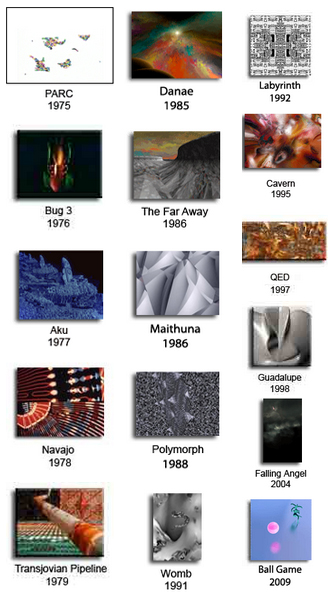
PARC was my first digital image. I made it on January 6, 1975 around 3:30 AM at the Xerox Palo Alto Research Center. It was the first time in my life I’d been in a room with a computer . After a few hours of working with the PARC system, I was sold on the concept that digital imaging was the next big step in the evolution of art.
Bug 3 was my first 3D character, an articulated insect I built in 1976 at Information International Incorporated (Triple-I), the first all-digital Hollywood studio. Creating art at Triple-I was incredibly difficult. I worked on a huge DEC 10 computer right out of a Fifties scifi flick, complete with blinking lights and spinning tape drives. It had a megabyte of RAM, a stupendous amount of memory back then. Bug 3 took me over a year to put together.
In 1977 I was invited to be the Artist in Residence at NASA’s Jet Propulsion Laboratory (JPL) in Pasadena. Aku was the first picture I made there. I worked on a Digital Equipment PDP 11/45 minicomputer the size of a horse. There was no commercial imaging software in those days. The programs were all one-of-a-kind applications handcrafted by individual programmers. Getting information about how the system functioned from them was like pulling teeth.
The programs I worked with at JPL were the most advanced 3D imaging applications of their day. In spite of their sophistication, the software was fairly fragile. Pictures often didn’t render on the screen the way they were supposed to. Sometimes I liked the unpredictability of the situation. When Navajo emerged from the rendering pipeline, it wasn’t what I was expecting at all, but I was just crazy about it.
After a while my whole approach to composing images underwent a conceptual transformation. I transitioned from the painterly notion of arranging forms on a surface to perceiving pictures as frames that open onto immersive worlds. Composing morphed into spatial exploration. Transjovian Pipeline came out of that process. Pipeline became my signature work and was reproduced in hundreds of books and magazines around the world.
One day in 1984 I woke up and realized I’d spent most of the last eight years in a dark room in a computer lab with radiation pouring into my eyeballs. I relocated to New Mexico and spent several months looking at light.
When I returned to JPL in 1985, the hardware had been upgraded to a DEC VAX 780 that displayed millions of colors simultaneously instead of the paltry 256 colors I’d been working with up to that point. Danae was one of the first images I made with that setup.
The Far Away is a frame from a virtual world I created that brought about a further evolution of my thinking. The environments I built were full of surprises I hadn’t actually intended in the original design. Whenever I ran across these anomalies, I’d document them. Without realizing it, over time my digital imaging process had become a form of snapshot photography, which loosened up my whole approach to making and taking pictures.
Around the same time, I started thinking of my images as life forms. I began to perceive them as frames in an evolving flow of dynamic compositions that grew into and out of one another.Maithuna is from a series of pictures that had a kind of genetic correspondence. In those days even big scientific computers were so slow that I often had to render pictures in extremely low resolution. A couple years ago I up-res’d the original file, so the final image took over two decades to produce.
In the late Eighties JPL’s NASA funding dried up. It was the end of an era. All the machines in the lab were still humming, but there were no warm bodies to care for them. The place took on the character of a ghost lab. Polymorph was the last picture I made there. Personal computers finally existed, small mammals that would soon topple the big dinosaurs of the computing world, but they weren’t sufficiently evolved to run the kind of software I’d been working with for over a decade. For quite a while I was at loose ends.
In 1991 Apple invited me to experiment in their Evangelism Group’s multimedia lab. I worked on a Mac IIfx with 32 megabystes of memory and a 1.3 gigabyte hard drive, the absolute bleeding edge in desktops then. I used off-the-shelf programs like Photoshop for the first time. I got interested in populating my virtual worlds and making the characters aware of their surroundings. Womb came from a world inhabited by a a tribe of electronic creatures.
